ITAM, Starting the IAM advanced training journey
(Wet roads, Bonneville manners and trying not to look like an idiot)
Nicola Ricks, October 2026
Who I Am
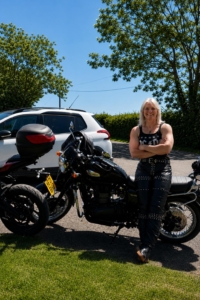
I have been riding motorcycles since I was 21. I am now 52, which is mildly horrifying when written down, but it does mean I spent a fair amount of my younger and (relatively) stupider years, on two wheels. Like many people, I had a break from riding when my children were born, because apparently babies, motorcycles and free time do not naturally coexist and we have to be something commonly referred to as a “responsible adult”
These days I ride with my dad, who is a member of EKAM and has been through the advanced training himself. He also happens to edit eNEWS so there was probably no escape from having to write this. His view was that it might prove useful to others thinking of doing the course if I were to go through my experiences from the training from a ‘live’ perspective. Particularly as I’m someone who is not brand new to riding but is new to advanced motorcycle training.
So – to start I found myself doing my ITAM, Introduction to Advanced Motorcycling, at Challock.
ITAM
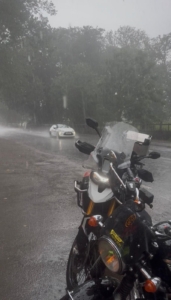
The day began indoors, which is always good when the weather outside is wet, windy and generally doing its best to make motorcycling feel as uncomfortable as possible. We started with a slideshow introducing the SYSTEM. This is the foundation of advanced riding, and served by a multitude of acronyms intended to instil the procedures to memory andmost of which I immediately failed to remember. The key take away though was this is not about riding faster, although improved progress might be a side benefit. It is about riding better: taking in information, positioning correctly, adjusting speed, selecting the right gear, and accelerating when it is safe and appropriate to do so. Oh, that’ll be ‘IPSGA’ then!
The classroom part was useful because it became clear that advanced riding is not some mysterious dark art performed only by strange men in hi-vis jackets who know every back road in Kent and can identify road camber by smell. It is a structured, practical method of riding very much based on observation, anticipation and planning. (Oh, another TLA).
An Observed Ride
Easy then. Except after that it was time for an observed ride. No nerves here..…
My observer was Chris, who took me out around the back roads near Canterbury. I do not know those roads particularly well, so I was entirely in his hands. For anyone who has not done an observed ride before, the observer rides behind you. There is no intercom. You watch for their indicators to know which way you are going.
All sounds simple enough until you are in a busy built-up area, trying to ride smoothly, read the road, watch the traffic, avoid potholes, look for signs, remember the SYSTEM, and also keep half an eye out for whether the person behind you is indicating left or right.
It is a bit like being followed by a very polite motorcycle-based sat nav, except it does not speak and you are slightly worried it is judging you.
And yes I was nervous at first. Not terrified, but definitely aware that someone who knew what they were doing was watching me ride. That is always an odd feeling. Most of us ride as we ride, nobody is usually there watching and preparing to give us structured feedback. Having someone behind you specifically observing your riding does sharpen the mind and makes you sometimes second guess yourself somewhat.
Chris, thankfully, was very chilled. That helped a lot. There was no sense of being tested or picked apart. It felt more like someone was watching to see where I already rode well and where I could ‘polish’ things.
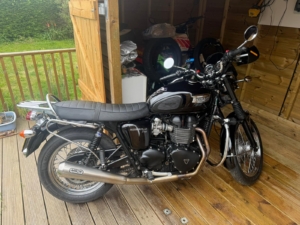
The weather added its own little layer of entertainment. It was wet and windy, and I was on my 2014 Triumph Bonneville. I love my Bonneville but it is not exactly a featherweight precision instrument. It also then had an aftermarket centre stand, now removed, which meant I had to be a bit careful with cornering clearance. Add to that a pair of aftermarket shocks (also now replaced) which had been set up by a previous owner who was larger and heavier than me, and the ride was fairly hard.
So, on wet roads, with wind, unfamiliar routes and an observer behind me, I was not exactly about to start pretending I was at the Isle of Man TT.
The Bonneville is a lovely bike, but it rewards a bit of respect, especially in poor conditions. Smoothness matters. Braking needs to be considered. Cornering needs to be tidy. Sudden inputs are not your friend. In fairness, that is probably true of most bikes, but the Bonneville has a way of reminding you that it is a proper lump of metal and not a modern electronic nanny on wheels. (That said , since then, replacing a pair of aging Metzler’s for some nice new Michelins has done wonders for the bike’s decorum).
Observer Feedback
We stopped about halfway through the ride, and Chris gave me some initial feedback. To my surprise, he was quite complimentary about my riding. That was reassuring, because I had spent the first part of the ride assuming I looked like someone who’d never even passed their initial bike test
The main point he raised was observation. Not that I was not looking, but that I needed to improve certain aspects of how early and how proactively I was using information. That is one of the interesting things about advanced training: it does not necessarily mean you are doing something badly. Sometimes it means you are doing something adequately, but that there is a better way to do it.
My biggest takeaway from the day was filtering. Specifically, I needed to be more pre-emptive with it. I can filter, and I am comfortable enough doing it, but advanced riding asks a bit more than simply deciding whether the gap is big enough. It is about reading the situation earlier, anticipating what other road users are likely to do, and making a decision before the moment becomes rushed.
Filtering is one of those areas where bikers can either make calm, sensible progress or turn into impatient little wasps. The aim, obviously, is the first one. The goal is not to squeeze through everything because you technically can. It is to assess the road, the traffic, the available space, the behaviour of drivers, the surface conditions and your own position, then act smoothly and decisively. And be safe.
Probably the clearest lesson of the ride for me was that I did not come away thinking I had to completely relearn how to ride. But I did come away thinking I needed to sharpen what I was already doing, especially in relation to earlier observation and planning.
Verdict
And that, I think, is one of the best reasons to try advanced training. It is not just for new riders. It is not just for people who lack confidence. It is not just for people who want to pass a test or collect a badge. It is for anyone who wants to understand their own riding better.
If you have been riding for years, it is very easy to assume experience automatically equals skill. Sometimes it does. Sometimes it just means you have been doing the same slightly scruffy thing for a very long time and nobody has had the nerve to tell you.
The ITAM and the observed ride was a good introduction because it was not intimidating. It was structured, practical and useful. There was no ego in it. No one was trying to turn me into a police rider in one afternoon. It was simply a chance to look at how I ride and identify where I could improve.
I also think more women riders should consider doing it. Not because women are delicate little flowers who might faint at the sight of a roundabout, but because motorcycling is still a space where women can feel more visible, more judged, and therefore may be more reluctant to put themselves forward. But this doesn’t put anyone ‘on the spot’. Training like this is not about proving anything to anyone. It is just about getting support, encouragement and expert advice to enable you to become a better, safer and more confident rider – for yourself.
Wet roads, wind, unfamiliar lanes, a slightly firm Bonneville and an observer quietly following behind me. Not an entirely stress free introduction but it was comfortable and with a very valuable set of outcomes. For me, the day was a useful mix of reassurance and a reality check. I was not as terrible as my nerves tried to tell me I was, but I also have clear things to work on. That feels like a good place to start.
This is just my individual take on a first day of advanced training. I hope it has been of interest and useful to at least a few of you. Unfortunately, as I’m signed up to do the whole course, this apparently means I now need to write the odd ‘progress report’ from time to time.
Until the next time then……..