October club night presentation – Nigel Stevens
by Barry Ricks, 23rd October 2026
Where to Start?
Perhaps with a short CV for Nigel Stevens; retired long serving police rider, member of EKAM since it first formed, ex EKAM observer, ex IAM Examiner, ex EKAM committee member (inc a stint as Chairman), occasional racer and a perpetually keen and enthusiastic club member and rider.
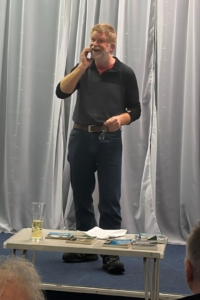
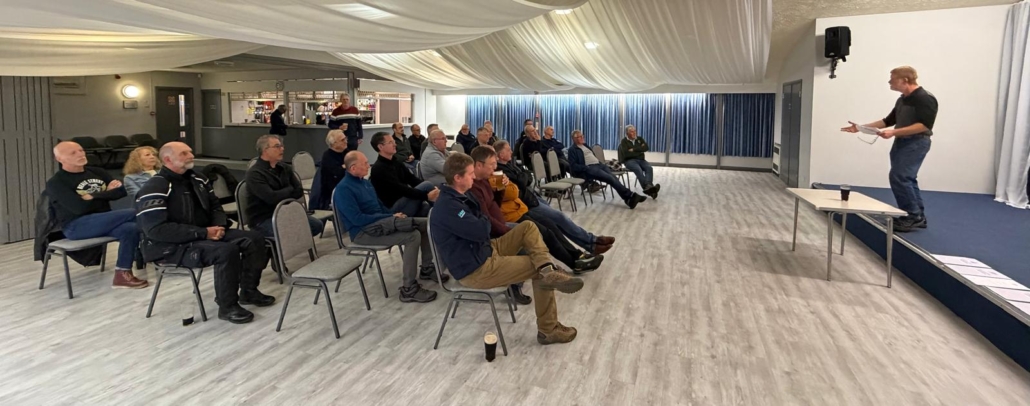
So, if you are one of the few club members who doesn’t know Nigel you’ll gather he’s learnt a bit about riding over the years and today is recognised within EKAM as one of the best riders in the club. At club night in October Nigel came armed with nothing more than a head full of knowledge and a couple of hours of spare time to explore the almost infinite topic of riding techniques.
Motorcycling Can be Dangerous
We had a lively evening, which inevitably over-ran and could have run for far longer. In fact as I write this article the discussions are still continuing via the club WhatsApp channel.
To start the evening Nigel referred to Jack Winslade’s session at the September club night and the accident stats for motorcyclists. The bald fact is bikers make up less than 1% of all “motorists” but over 25% of the road fatalities. Most of those fatalities could, or even should, have been avoidable. Avoiding such disasters is what riding to IAM standards and skills are intended to achieve.
Nigel also pointed out that although 75% of motorcycle crashes occur in urban environments some 70% of rider fatalities happen on rural roads. 30% of those fatalities involved a rider losing control into a bend.
So having focused on the risks the discussion opened up and brought alive all those acronyms we are so fond of – OAP, IPSGA, TUG and so on as we moved on to an overview of IAM standards and ‘Roadcraft’. Nigel produced a copy of every edition of ‘Roadcraft’ going back to a first edition copy issued to him as a policeman in the 1990’s to demonstrate how it has evolved over the years. The book is fatter now…..
A broad discussion on the ‘System’ and safe riding techniques then followed. I will not detail it in depth here, everything can be found in Roadcraft and the IAM manual. Although I might mention that Nigel takes the view that the ‘A’ in IPSGA should equally stand for something like ‘Application’ – as we won’t always accelerate !
Then the discussions took a wider turn beyond IAM standards and we got on to the subject of ‘Trail Braking’……
Trail Braking
This topic took a large part of the evening. Trail braking is a much misunderstood technique and although it doesn’t figure as part of the IAM curriculum Nigel spent much effort clarifying some misconceptions.
Trail braking isn’t about applying the brakes into a bend to slow down, nor is it the ‘track only’ technique that racers can use to be faster around corners.
Trail braking is simply extending the braking phase on our approach to a bend beyond the point where we initiate our turn into the bend. It therefore overlaps braking and steering.
There are times in road riding when this can be advantageous, there are also times when it is essential. Nigel explained this by using the system to break down the various stages we go through when approaching a typical left hand bend.
Roadcraft dictates that an Advanced rider will always be able to stop on their side of the road in the distance that they can see to be clear.
This rule pretty much dominates speed selection on the approach to any bend with a restricted view into it.
As a rider initially approaches the bend they will have a view to the vanishing point and the majority of this view will be in a straight line. This view is used to assess the severity of the bend and speed is adjusted accordingly. As they approach the bend the amount of straight road ahead decreases, the amount of curved road increases, and the view and speed assessment continues. The advanced rider will still be able to stop in this distance that they can see to be clear. Unless they have reduced their speed to such that they can stop in the available straight road still in front of them they are already planning on braking in the bend should it be necessary to stop. In essence the distance they can see to be clear is no longer a straight road
Now Roadcraft, and the interpretation adopted by the IAM, requires the rider to have finished braking, selected the appropriate gear, and applied sufficient acceleration to place the motorcycle in a balanced stable condition before they enter the bend. In principal this is a sound basis to adopt, however it does raise questions around what to do if the view is still reducing at the point the rider needs to initiate the turn. Consider road conditions which are so steeply downhill that the motorcycle will accelerate if the brakes are released, or circumstances where there might be a sudden need to stop in the bend.
We then went into some basic explanations around motorcycle dynamics, how weight is transferred between the front and rear wheels through the use of the throttle and brakes, and how this weight transfer effects suspension geometry and tyre grip.
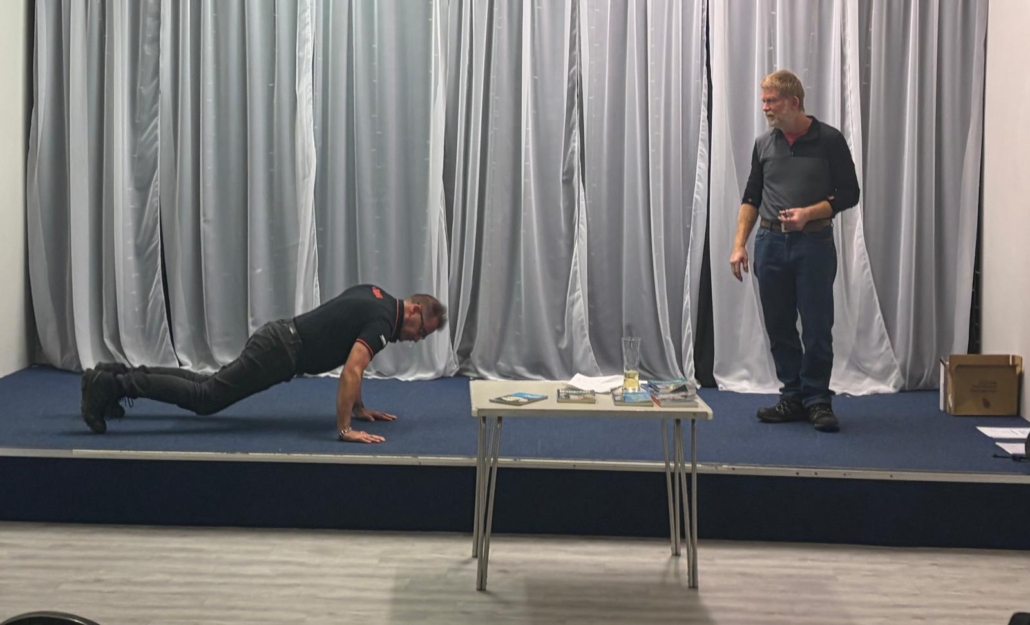
To help explain this Tony Green offered himself as a ‘test exhibit’ to demonstrate the advantage of pre-loading the front tyre as would be the case under trail braking. Whist prone on the ground in a ‘Push-Up’ stance, albeit with his arms stretched out in front of him and therefore with more weight on his legs, he demonstrated it was easy to push forward and cause his hands to slide on the floor. However, with his hands positioned below his torso, the load and therefore the grip between floor and hands was increased and it was not possible to cause them to slide.